
Via gasworld
(het oorspronkelijke artikel vind je hier)
Green hydrogen continues to fall behind projections, and with challenges such as grid congestion, water scarcity, and the high cost of electrolysers, the gap between expectations and reality will likely widen.
That was the reality delivered by Jan Rongé, CEO of Solhyd, in a recent presentation delivered on the eve of Nippon Gases’ plant opening, attended by gasworld.
Rongé emphasised that rising demand and pressure on green hydrogen calls for new innovations to accelerate production.
In recognition of the challenges, Solhyd is taking a different approach to producing hydrogen, compared to many who are using electrolysis technologies.
The Belgium-based business is utilising the solar opportunity, which it says is huge.
Rongé shared a statistic showing the rapid rise in solar PV capacity, particularly from 2020 onwards. It also showed that, as of 2023, solar was the fastest-growing renewable energy source, overtaking wind and hydropower.
“Solhyd makes hydrogen without water and electricity and instead uses solar,” he told attendees. “Water has come under scrutiny recently due to an increase in droughts and this is even more common in regions with high levels of renewable energy. It’s important that this is noted as we look at water as a key ingredient for producing hydrogen.”
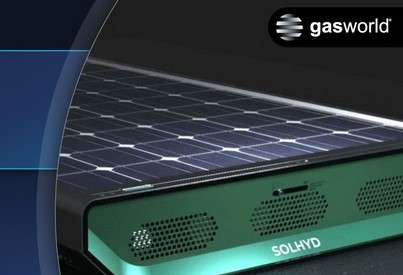
Instead of water and electricity, like a conventional electrolyser, Solhyd’s hydrogen panels use solar energy to produce hydrogen. These are much akin to classical solar photovoltaics, but instead of an electric cable are connected via gas tubes.
“The fundamental difference between our technology and other technologies is that we produce energy. We don’t consume it,” Rongé said.
“Solhyd’s technology is compatible with almost all commercial PV modules because this industry exists at scale at very low cost. Solar panels cost next to nothing these days, so we tapped into that and made the decision to rely on the robust technology.”
The hydrogen panels capture moisture from the air and use sunlight to split water molecules into hydrogen and oxygen. They are similar to traditional solar panels but produce hydrogen gas instead of electricity.
Additionally, the technology operates independently of the electricity grid.
“This avoids stressing the grid and sidesteps issues like congestion,” Rongé added. “There are several companies in the Netherlands facing issues getting new grid connections, and solar farms can’t even feed electricity into the grids because they’re completely full.”
Scale-up must happen
Solhyd is piloting its technology in Belgium with 20 hydrogen panels. The project is already producing hydrogen for multiple use cases.
“This is a small project,” Rongé said, “but it’s our first pilot. In this project, we produce hydrogen from air and sunlight. We compress it locally, we store it locally, and it’s also locally being used.”
Solhyd is cautious about pricing, too, and wants to be competitive on this front.
“As a company, we have made assessments of the production costs for hydrogen. Today, we are already not so far from electrolysis technologies, and we are still in the early stages of developing our products.”
By 2030, or even before that date, the company wants to reach a price of less than €7 per kg in Belgium. Rongé compared this to the general forecasts for green hydrogen production in Belgium, which he believes are higher than €10 per kg.
He added, “To achieve this, we need to scale up, and we know that. We plan to be at the megawatt scale by 2027. We are aware this is still relatively small, but from there we will keep growing.”
Make room for hydrogen panels
One question raised about the hydrogen panels is the spacing issue when it comes to scaling projects. “That is no problem at all,” Rongé told the room.
“With just 500m²—the size of a small company roof—you can produce one tonne of hydrogen per year in Belgium.”
This is still on a small scale, so how can the technology fit further down the line? Solhyd is looking at harmonising hydrogen and agricultural space.
“In Belgium, if we were to use 1% of the agricultural area to make renewable hydrogen, with this strategy, Solhyd would be able to produce 9% of the industrial natural gas consumption,” Rongé explained.
“On a European level, if we use just 4% of the agricultural area, we can completely replace natural gas demand in the EU with hydrogen. Of course, nobody’s planning to do that, just to be clear. But this shows that there is potential.”