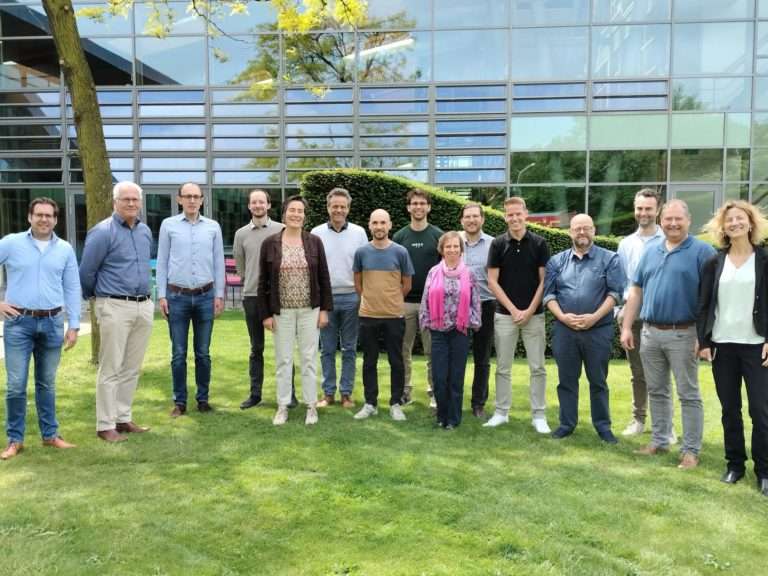
In the ‘Smart dHYstrict’ project, Belgian and Dutch players will cooperate across borders around hydrogen in the built environment. They want to investigate how to use hydrogen in a cost-efficient way to make a local energy system more sustainable, and to do so at two pilot sites in both countries. Today, all project partners of ‘Smart dHYstrict’ gathered in Turnhout for a kick-off meeting with grant provider Interreg Flanders-Netherlands. The latter approved the project, which will run for three years, last summer.
Green Energy Park
The two living labs will be complementary in concept. The first location is ‘Green Energy Park’ in Zellik in Flemish Brabant. This is a comprehensive living lab in which distribution networks for electricity, gas, hydrogen and heat will be made available to optimally deploy the various energy flows. ‘As part of this project, we are going to build an energy system on a small scale in their ‘Smart Village Lab’ where we want to demonstrate with limited power the coupling of production and use of hydrogen through a distribution network, driven by a smart energy management system. In a follow-up project, this can be scaled up to a larger part of the Green Energy Park site with the participation of larger users,’ Stefan Neis, project manager at project leader WaterstofNet, told us.
VDL
The second location is a VDL industrial site in North Brabant, where a local microgrid will be built to become largely independent of the electricity grid. In this ‘grid-poor’ test site, the focus is on storage of locally generated energy in the form of hydrogen, which is bonded to a solid carrier. ‘The objective is to make the energy supply as independent from the electricity grid as possible,’ adds Stefan Neis.
Reduce load on electricity grid
In both living labs, the ultimate goal is to investigate methods to drastically reduce the load on the electricity grid, through optimal local consumption and temporary storage of excess energy in the form of hydrogen. To this end, Smart dHYstrict will test different configurations, including in hybrid combinations with heat pumps, under truthful conditions and with the help of a smart energy management system (EMS).
Smart Europe
This project contributes strongly to the ‘Smart Europe’ goal of Interreg VL-NL: to provide energy with minimal CO2 emissions through efficient deployment of different energy carriers and guided by a smart EMS. In the living labs, future users can experience how the combination of different energy carriers, including hydrogen, can make a local energy system cost-effectively carbon-neutral.
Strengthening support
In cooperation with the living labs, WaterstofNet will organise visits and workshops to inform companies, stakeholders (licensing authorities, fire brigades, etc.) and local authorities about the project result.
One of the aims of the living labs is also to introduce the wider public to hydrogen and demonstrate that it can be used safely. All kinds of organisations, such as educational institutions, NGOs, installation companies, etc., will eventually be able to visit the living labs.
Besides VDL Klima (NL) and Green Energy Park (BE) – the partners in which the living labs will be built – the Smart dHYstrict consortium consists of: technology developers Solhyd (BE) and NEWES (NL), knowledge organisations The Vrije Universiteit Brussel (VUB) and Gas.be (BE), distribution system operators Fluvius (VL) and Enexis (NL), high-tech company Priva (VL,NL) that will develop the EMS and project coordinator WaterstofNet (VL,NL).
More info at: interregvlaned.eu (in Dutch)
Smart dHYstrict is financed by the programme Interreg Vlaanderen-Nederland. This programme receives support from the European Fund for Regional Development (EFRO).