
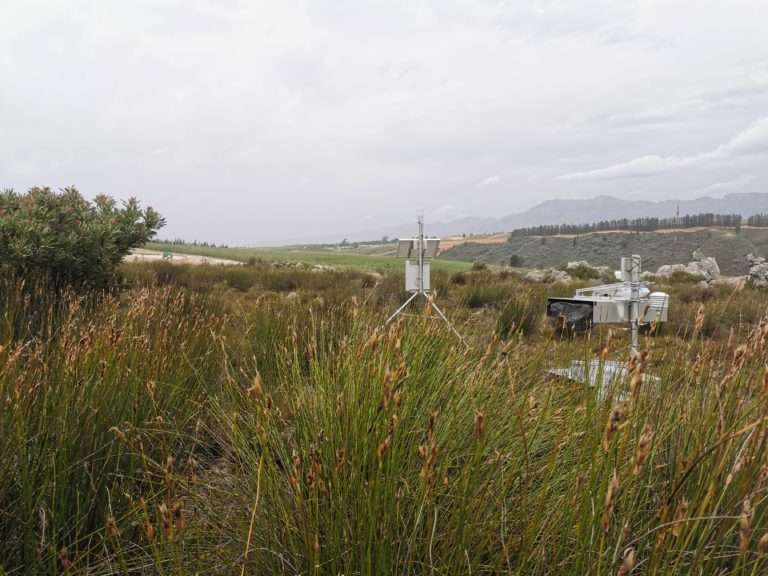
It is foreseen that hydrogen panels could be used around the globe. In this regard a research project has been commissioned to establish the potential of hydrogen panels at a site near Cape Town, South Africa. The operation of hydrogen panels is largely dependent on the weather conditions, specifically the relative humidity and solar radiation. Therefore the research focuses on the interaction of the panel with these weather parameters in the climate of the Western Cape. The implementation of lab knowledge in the field also provides for unique and unforeseen challenges. The project aims to identify these challenges early on so that they can be addressed.
A field test for water capture
The field test site currently consists of a weather station and a Solhyd hydrogen panel water uptake prototype. The weather station consists of two separate installations: a stand containing a ClimaVUE50 integrated weather sensor, as well as a stand containing four equally spaced relative humidity/temperature sensors and a camera. These two installations are spaced three meters apart and connected via an underground cable. The system has been designed to monitor temperature and relative humidity at different heights above the ground in order to investigate the delicate interaction between the hydrogen panel and its microclimatic environment, and to determine the height at which a hydrogen panel should be installed for maximum water uptake.
An important step towards Solhyd hydrogen production outside Europe has recently been made with the installation of a water uptake prototype at the site. Although the prototype has not been built to produce hydrogen, it serves to provide insights into an important step in the air-based solar hydrogen production process: harvesting water from the air in outdoor conditions.
Modeling climate effects
Renewable energy technologies are typically dependent on environmental parameters, such as solar irradiation or wind speed. For Solhyd hydrogen panels, there is an even more intricate relation with natural phenomena. In locations with high solar irradiation, our system must be able to capture enough water to convert all the solar energy into green hydrogen. Conversely, in locations with less irradiation it is typically easier to capture sufficient water, with positive effects on process efficiency. Results from laboratory experiments, in combination with data gathered at outdoor sites, are being used to model and predict the performance of Solhyd hydrogen panels. We are learning to understand the behavior of the system better every day, and our ultimate aim is to accurately predict performance of the technology based on climate data, anywhere on the planet.